Matter proposes interoperability for connected-home devices, but a standard does not replace checking a specific experience. For a brand or demonstration project, distinguish certification, available compatibility and actual operation before promising an easy connection for everyone.
Matter and the question that matters to the user
The need is usually expressed as an action, not a protocol. Someone wants to switch on a light, share control or recover a device after a change. Before choosing products, describe these tasks and their environment. Then evaluate whether a proposal reduces difficulties or merely adds another interface. A technical demonstration must address that journey, not just show a device appearing on screen.
The Connectivity Standards Alliance FAQ presents Matter as local connectivity technology and explains controllers and platforms. This reference helps formulate questions but establishes no particular equipment combination. Design must verify components and functions available in the specific project, without making the standard’s name a general compatibility guarantee.
Separate documentation from installation
A specification capability does not demonstrate every product implements it. Before preparing an experience, identify model, version, requirements and relevant functions. Distinguish the end device from its controller and operating application. Two devices may share a label yet offer different journeys, especially with manufacturer-specific configurations or features the public still needs to understand.
A project brief can record what was checked and what remains pending. If a feature appears only in documentation, present it accordingly until tested in the intended combination. This article lists no current versions or purchase recommendations: those details change and require verification for implementation time and country. The goal is reducing ambiguous promises, not replacing technical review with another terminology list.
Design installation as part of the experience
The first connection influences how people understand the product. Readable instructions, access to necessary elements and clear action order can matter as much as the final feature. Observe where questions arise: device recognition, platform choice, permissions or confirmation. If only the demo preparer can complete installation, work remains to understand someone’s experience without that context.
Applied Design Thinking offers a reference for exploring needs and testing proposals. Observation should focus on specific tasks rather than persuading people technology is simple. When difficulty arises, record the producing condition. That information can improve instructions, adjust expectations or acknowledge a limitation worth explaining instead of concealing.
Sharing control does not mean sharing every access
Alliance documentation describes multi-admin for connecting devices to different user-chosen platforms. Technical possibility does not remove agreement on who can control what. A project must review how access is granted, recognized and withdrawn in its actual configuration. Do not assume platforms present identical options or retain the same behavior on every device.
In demonstrations, permissions must remain bounded and personal accounts must not be involved without authorization. With several participants, the team needs an environment-reset procedure between sessions. One successful shared test establishes neither isolation nor recovery. This separation matters when public experiences use domestic technology: exhibition context may require controls different from those used at home.
Understand dependence on external connectivity
Local operation and remote access are different questions. The organization’s FAQ explains that control from outside the home may require an internet-connected controller or another manufacturer-provided route. Do not infer identical operation under every network condition. Describe the tested task and components supporting that particular journey.
This enables alternatives when a dependency is unavailable. If an experience requires external connectivity, test it in the intended place and conditions. If a part works locally, check it separately. Public communication should avoid absolute continuity promises. Design acknowledging dependencies can be clearer and more trustworthy than design showing only the best case in a controlled presentation.
Test recovery, not just the first switch-on
A consistent experience needs a way back to an understandable state. The team can evaluate restart, authorized access change or dependency loss within a permitted test environment. Every case needs an expected result and verification method. Learning need not involve causing failures in real customer installations: a lab can use authorized test components and accounts.
Tests should retain versions and enough configuration for someone else to understand the result. Video of a functioning device does not itself explain preparation, required conditions or what happened afterward. For a brand experience, technical closure also has a service dimension: who helps, which instructions participants receive and what they should not attempt to resolve alone.
Communicate usefulness without a universal promise
The proposal should explain an improvement that can be shown. It might be fewer steps or a more understandable way to control a space, if testing confirms it. Do not claim Matter eliminates all interoperability problems or makes every object smart. Technology can be valuable with a specific scope, provided that scope is described without exaggeration.
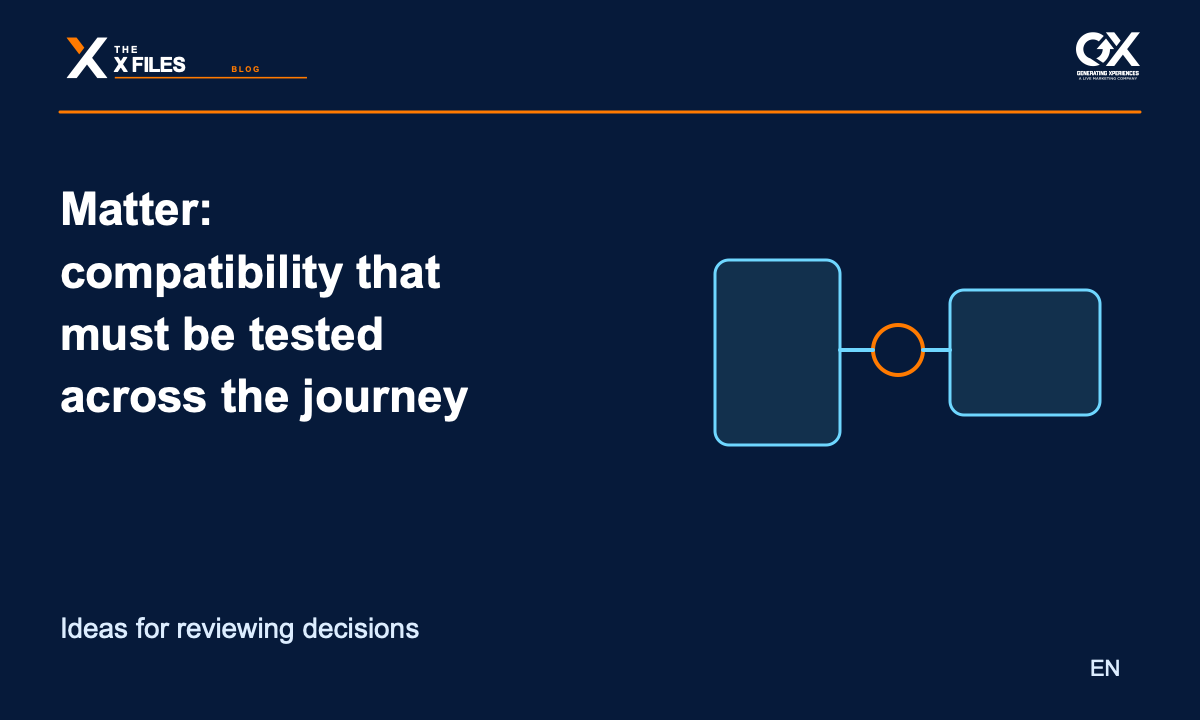
Visual content can show relationships between components and actions. A diagram should distinguish device, controller, platform and external dependency instead of connecting everything with arrows implying already operational integration. Equipment depicted in a cover or editorial demonstration should be identified as illustrative when it does not correspond to a verified installation.
A fictional example of a bounded demonstration
Imagine an experience helping visitors understand lighting changes in a test space. The journey begins with a clear task and ends by restoring the initial state. The team verifies the component combination, explains available actions and avoids requesting visitors’ personal accounts. This example describes neither a GX setup nor installation of the standard at a specific venue.
Evaluation can observe understanding, completed steps and difficulties without presenting interaction count as proof of commercial improvement. Reading about measuring brand experiences helps formulate these questions. Learning may show instructions need changing, a feature is irrelevant or the demonstration needs more support than anticipated.
Move from concept to verifiable scope
The next decision must separate content, prototype and installation. An editorial piece explains a concept; a demo tests a combination; operations need owners, support and sustainable conditions. Each stage has distinct evidence. Design approval does not authorize accounts, permissions, networks or real-device access. This separation enables progress without promising an idea already works outside the lab.
To explore a connected-technology experience, present it to GX with purpose, environment and constraints. The channel confirms neither installation nor compatibility. Discussion should identify the task to demonstrate and resources reviewable with authorization. A useful proposal keeps this precision from the first diagram through testing the journey people will see.
A check to bring to the review. A demo script can record initial state, visitor task, expected result and environment recovery. Add specific models and versions only once verified, not as general buying recommendations. If an action requires team assistance, that assistance belongs to the journey and should be observed. The result is not merely that a light changed, but a precise account of who could change it, under which conditions and with what limitations.
Explore more insights in our X Files Blog
Visual content: bringing clarity to the brand message · The X Files Blog · GX: Choose images and formats for what they help explain, not just their visual impact.
Measuring brand experiences with clear criteria · The X Files Blog · GX: Useful measurement begins with the question you need to answer, not the biggest figure.

Sources
Connectivity Standards Alliance: Matter FAQs. A reference on local connectivity, controllers and multi-admin. No devices were tested and no installation compatibility is established. Examples and evaluation sequence are editorial work.
Frequently asked questions
Does the Matter label guarantee every equipment combination?
Do not assume so. Review specific models, versions, functions and controllers, and test the journey you intend to offer.
Does everything work without internet?
That is not a universal conclusion. Matter includes local connectivity, while remote access and other functions may depend on additional components or services. Verify the specific case.
Does a demonstration justify declaring an operational installation?
No. The demo establishes only tested conditions. Installation, identity, permissions, support and recovery need their own review and acceptance.